Understanding the Source-to-Pay process
Objective: Master the steps of the procurement process and understand how each one contributes to responsible purchasing.
The procurement process is relatively simple and intuitive: Needs definition → Sourcing → Contracting → Order placement → Receipt and payment. It can be as simple as swiping a credit card or as complex as a multi-year tender.
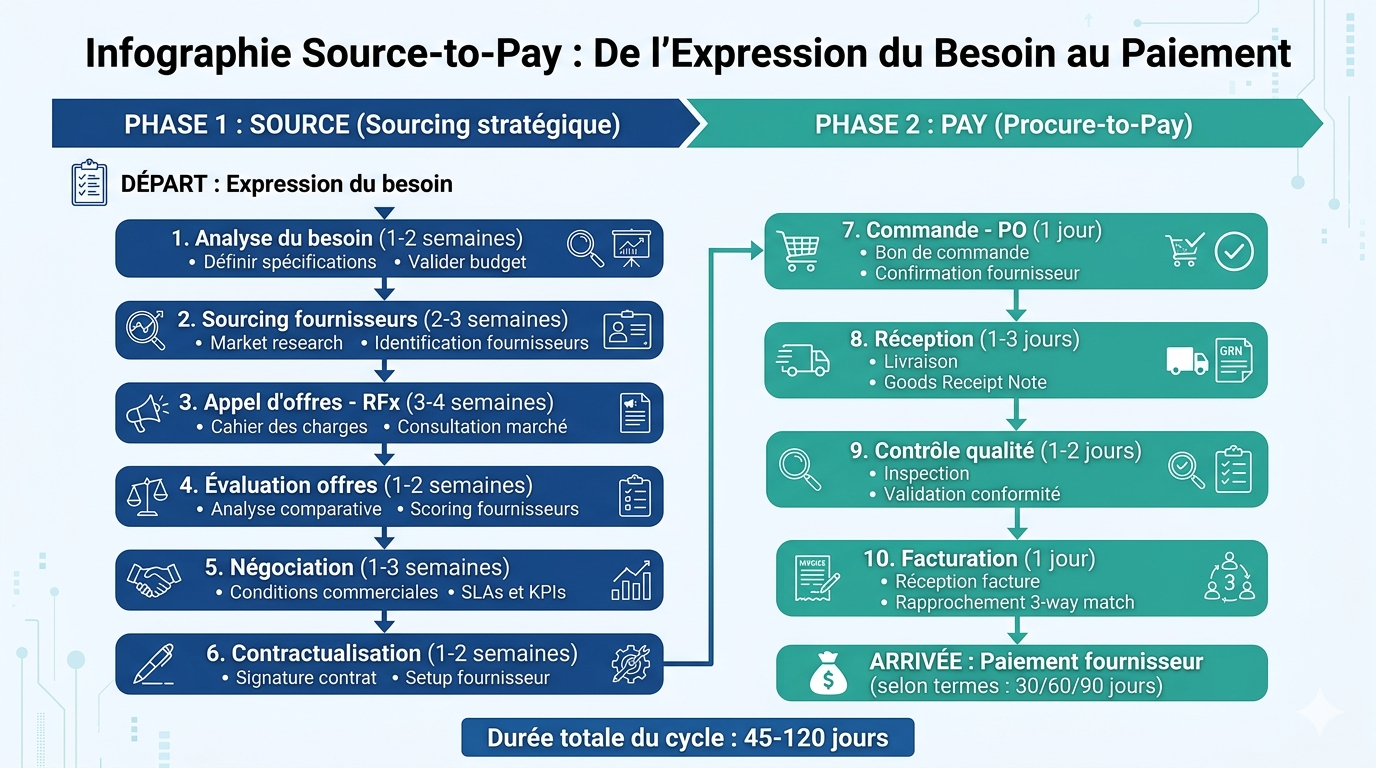
The end-to-end Source-to-Pay process
The 5 steps of the procurement process
- Needs definition: Challenge requirements, rationalize demand, explore sustainable alternatives, TCO (Total Cost of Ownership) analysis
- Sourcing: Identify suppliers, competitive bidding (RFPs, benchmarking), evaluate QCD + CSR criteria, risk assessment
- Contracting: General terms and conditions, risk management, SLAs, CSR clauses, GDPR compliance
- Order placement: Issue purchase orders (POs), internal approvals, supplier performance tracking
- Receipt and payment: Quality control, discrepancy management, 3-way matching (PO / delivery note / invoice), payment terms optimization
The cost of processing an order
The number of steps in a procurement process creates a sometimes-high level of complexity. Processing an order costs on average €100, and up to €200 when invoice handling is included. It is therefore vital to have a simple and streamlined process.
🏢 Example: L'Oréal and the procurement process
L'Oréal, with over 50,000 suppliers worldwide, implemented a fully digitalized Source-to-Pay process, reducing the order processing cost from €180 to under €15. The group has evaluated every supplier on CSR criteria via the EcoVadis platform since 2014.
⚠️ The myth of negotiation
Contrary to popular belief, negotiation accounts for only about 10% of value creation in a procurement process. The image of the "haggler" is a stereotype that does a disservice to the profession. The real performance levers lie upstream: needs rationalization, TCO, innovation, consolidation, standardization...
👉 To dive deeper into strategic sourcing and negotiation techniques, see the Strategic Sourcing course.
The evolution of procurement practices
Procurement practices have evolved in response to the limitations of each approach:
- Purchase price view → choose the cheapest option. Problem: does not account for hidden costs (maintenance, breakdowns, premature replacement). Frequent result: "buying cheap costs dear."
- Total cost view (TCO) → integrate maintenance, energy, and end-of-life into the analysis. Problem: still ignores environmental and social impacts not reflected in the price -- the externalities.
- Life Cycle Assessment (LCA) → account for environmental and social externalities across the product's entire lifecycle. This is the level of analysis expected from the responsible buyer.